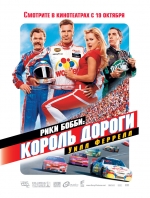
Talladega Nights: The Ballad of Ricky Bobby
Talladega Nights: The Ballad of Ricky Bobby
Ricky Bobby is a world-class NASCAR racing driver. Ricky adheres to the principle of "win at all costs", which makes him a national hero. He and his loyal friend Cal Naughton Jr. always occupy the first and second places, respectively; admiring the fearless racers, their devoted suitors nicknamed them Thunder and Lightning. When the unchanging leaders were challenged by the French Formula 1 pilot Jean Girard, Ricky had to prove his superiority, fighting not only with a dangerous opponent, but also with himself... Read more Ricky Bobba (Will Ferrell) always dreamed of driving a car, exactly like his father, Rhys Bobba (Harry Cole). The father abandoned the family, being obsessed with racing. Rika's mother, Lucy Bobba (Jane LYNCH), has long been in a bad mood: she was afraid that her son would become a professional racer, and, consequently, a person "without brakes". Ricky Bobby becomes a racer in the blink of an eye. He works as a mechanic for a leisurely racer, Terra Shevo (Adam McKay). While Terry sits and eats his chicken sandwich, his car is being repaired. Suddenly Ryky jumps into the car and... from that very moment, the legendary story of Ryky Bobba begins. Ricky becomes a rising star of the NASCAR racing series, he has his own team - Captain Lucius Washington (Michael Clarke Duncan), three loyal mechanics and Ricky's racing partner - Cal Noughton (John C. REILLY), a childhood friend. Ricky Bobba quickly becomes the best racer in the world. He has a full "gentleman's" kit of the NASCAR champion - a gorgeous wife Carla (Lesley BIBB), a mansion on the shore of the lake, two tomboy sons with the nicknames Cool Walker and Texas Ranger, plus huge sponsorship infusions and a series of victories, from Daytona to Darlington. Ricky Bobba became a national hero because he used to win "at any cost". Only soon it becomes clear to him that both in racing and in life one should be more careful "at turns". The challenge to the most popular American driver is thrown by the number one driver of the European "Formula 1" series, the Frenchman Jean Giraud (Sasha Baron Cowan). Ryky is forced to perform on the edge of the possible in order to defend the title of champion, and during one of the racing stages he gets into a terrible disaster. In the hospital after the accident, his nerves fail - this is how the black streak in Rika's life begins. All the laurels, including his wife, go to friend Kal. Ryky Bobba leaves the world of high speeds and moves with his sons to his native town to his mother. If you remember the races, then life in this small town flows terribly slowly, and Ryky is completely depressed. With a heavy heart, Rika's mother turns to the only person who can help her son - to her ex-husband Rys Bobba. Rhys still has a few racing tricks that help Rick overcome his fear of racing. Ricky Bobba is ready for anything, so that, despite life's flaws, he will again fight with his main rival and pave the way to glory. HISTORY OF FILMING The idea of the film belongs to Will Ferrell and Adam McKay, they have been writing scripts together since they met on the set of the show "Saturday Night" ten years ago. Ferrell worked then in the film crew, and McKay was a writer. Friends leave the program together - this is how their creative union began. For several years, the idea of filming a comedy about NASCAR racing has been swirling in the heads of friends like a car on a track. "While Will was filming Elf, we talked about this race all the time," McKay recalls. "We were in New York, where Will took a break before starting work on The TV Host. And then we got to the NASCAR races and saw how the world of racing was transformed - it seemed to us huge and beautiful. At that time, we were not yet racing fans, but after watching the competitions, we became them." It was the producer of Ricky Bobba's film who invited his friends to the NASCAR races held in the state of California. It was there that Ferrell and McKay felt what speed was like, the smell of gasoline and the roar of engines. "When we heard a whole chorus of roaring engines, we immediately realized that it was worth making a movie about," says McKay. "A huge crowd of spectators will fill the whole city, there are campsites and bonfires along the tracks... I was told that every hour during the races at the Talladega track (UAW-Ford Cup) a huge number of people gather, it is quite possible to make the second most populous city in the state of Alabama." Ferrell is a longtime sports fan, and as a student at the University of Southern California, he wrote a degree in sports commentary. True, in the future he still chose the career of an actor. By the way, he only knew about racing by hearsay until, finally, he got to the competition in Fontana - that was the fateful day when it was decided to shoot a film about NASCAR. "I knew that NASCAR racing was getting more and more popular," says Ferrell. "I was acquainted with some famous pilots and, in fact, I myself understood the sport quite well. But I did not know the other side of the ego - the intensity of passions, the highest degree of tension. I had to think about all this when we were creating the image of Ricka Bobba. The trick was to make a comedy and a movie about racers at the same time. We wanted to convey the inner state that you experience while watching the cars that rush along the track at a speed of 200 miles per hour." In working on the project, the authors of the film enlisted the support of NASCAR race organizers: the film crew was allowed into the working areas of the most popular race tracks in America. "We are glad that the organizers joined the work on the film," says the film's producer, Judd Apatow. "Still in the early stages, in the hope of cooperation, we showed them the script. If we had received a refusal, we would have turned to other organizers. But NASCAR picked up on the idea: besides, it was nice to see that these people are not devoid of a sense of humor and that they let us so close. While we were filming, a guy from NASCAR started making jokes even funnier than our own. Further - more. It turns out that these people can fly at a speed of 150 miles per hour and at the same time look at the world with even more humor than we do." The executive directors of NASCAR Richard Glover and Sara Netting worked very closely with the film crew: they monitored the correctness of the technical side of the narrative and the video sequence. In addition, they contributed in every way to the fact that the group could work in the mode of real races. Actors Michael Clark Duncan, David Koechner, Ian Roberts and Jack McBrayer went through a real mechanic's school - they learned how to use a jack, change a car in record time. Ferrell also learns to "jack" a car on which a wheel is changed. After spending several hours in training, the actors-mechanics reduced the time allotted to changing a wheel to 22 seconds seconds," admits Roberts, who plays Kyle in the film. "We could only manage 22 seconds - and if we were put on the track with such indicators, we would have overwhelmed the competition." "Personally, I was proud of our indicators," objected Ferrell. "I heard from the pilots that stopping for 22 seconds is a quite acceptable time for races in the lower categories, for example, for Busch or ARCA. So it is not necessary to say that we are no good. I don't know how I played, but I learned how to change a wheel in 22 seconds." "People from NASCAR helped us a lot," shares McKay's impressions. "They were open to communication and friendly throughout the filming. We also made friends with the owners of the teams and the pilots themselves. Without this friendship, no one would have let us near the races. At the same time, it was quite problematic to film the races themselves, because for this it was necessary to approach the hangar or pit stop, and when such an opportunity arose, it was necessary to film very quickly." Even before the start of filming, McKay and the film's producers considered abandoning the mode of real racing. But where can you get this genuine jubilation of the crowd, this unique racing fever, how can you not immerse yourself in this exciting atmosphere of NASCAR? "And then David Householder, our executive producer, convinced us that we should try," McKay recalls. "He was sure that the value of the film will only increase if it is filmed in the mode of real races, because nothing can replace the atmosphere of the track, to which a crowd of 200 thousand fans reacts - this is impossible to achieve with any direction. Of course, from a rational point of view, it was pure madness - to play a comedy in the middle of the races. And yet, we did not miss a single episode, we took everything possible from the races was to take". To give the film even more credibility, real sports journalists and commentators covering NASCAR races were invited to the picture, such as Darrell Waltrip, Larry Mike Reynolds, Benny Parsons, Bill Weber, Wally Dallenbach, Bob Jenkins and Dick Berggren. Thanks to NASCAR, the film group "filled" its picture with exciting and exciting episodes from the real sports world. Having worked at NASCAR races, many actors and members of the film crew became avid fans of qualifying races. "Now every Sunday I watch the race on TV," admits McKay. - "I know all the drivers by name, I know who has which car. I think that if you have seen NASCAR races at least once, got acquainted with their strategies and the technical side, you will become an avid fan whether you like it or not. Now a part of my soul is forever devoted to racing."
Open trailer
Director board
Browse production feed

Production feed
Browse production feed

Genres
-
 Drama (3795)
-
 Comedy (2460)
-
 Thriller (1618)
-
 Action (1236)
-
 Series (1088)
-
 Adventure (1019)
-
 Horror (818)
-
-
 Sci-Fi (808)
-
 Family (667)
-
 Animation (613)
-
 Mystery (536)
-
 Fantasy (532)
-
 Melodrama (520)
-
 Documentary (443)
-
-
 Biopic (355)
-
 Historical (219)
-
 Music (184)
-
 War (144)
-
 Short (112)
-
 Musical (106)
-
 Festival (97)
-
-
 Biography (85)
-
 History (72)
-
 Western (70)
-
 Mystic (46)
-
 Erotic (44)
-
 Stage Play (35)
-
 Military (33)
-
-
 Noir (16)
-
 Concert (15)
-
 Kids (12)
-
 Comic Book (11)
Release years
-
 2026 (367)
-
 2025 (330)
-
 2024 (355)
-
 2023 (428)
-
 2022 (484)
-
 2021 (487)
-
 2020 (582)
-
-
 2018 (761)
-
 2017 (789)
-
 2016 (717)
-
 2015 (524)
-
 2014 (415)
-
 2013 (189)
-
 2012 (77)
-
-
 2010 (63)
-
 2009 (75)
-
 2008 (68)
-
 2007 (64)
-
 2006 (47)
-
 2005 (57)
-
 2004 (48)
-
-
 2002 (42)
-
 2001 (43)
-
 2000 (44)
-
 1999 (34)
-
 1998 (22)
-
 1997 (26)
-
 1996 (20)
-
-
 1994 (20)
-
 1993 (15)
-
 1992 (17)
-
 1991 (15)
-
 1990 (21)
-
 1989 (14)
-
 1988 (20)
-
-
 1985 (14)
-
 1982 (12)
-
 1979 (11)
-
 1966 (10)
-
 1957 (11)